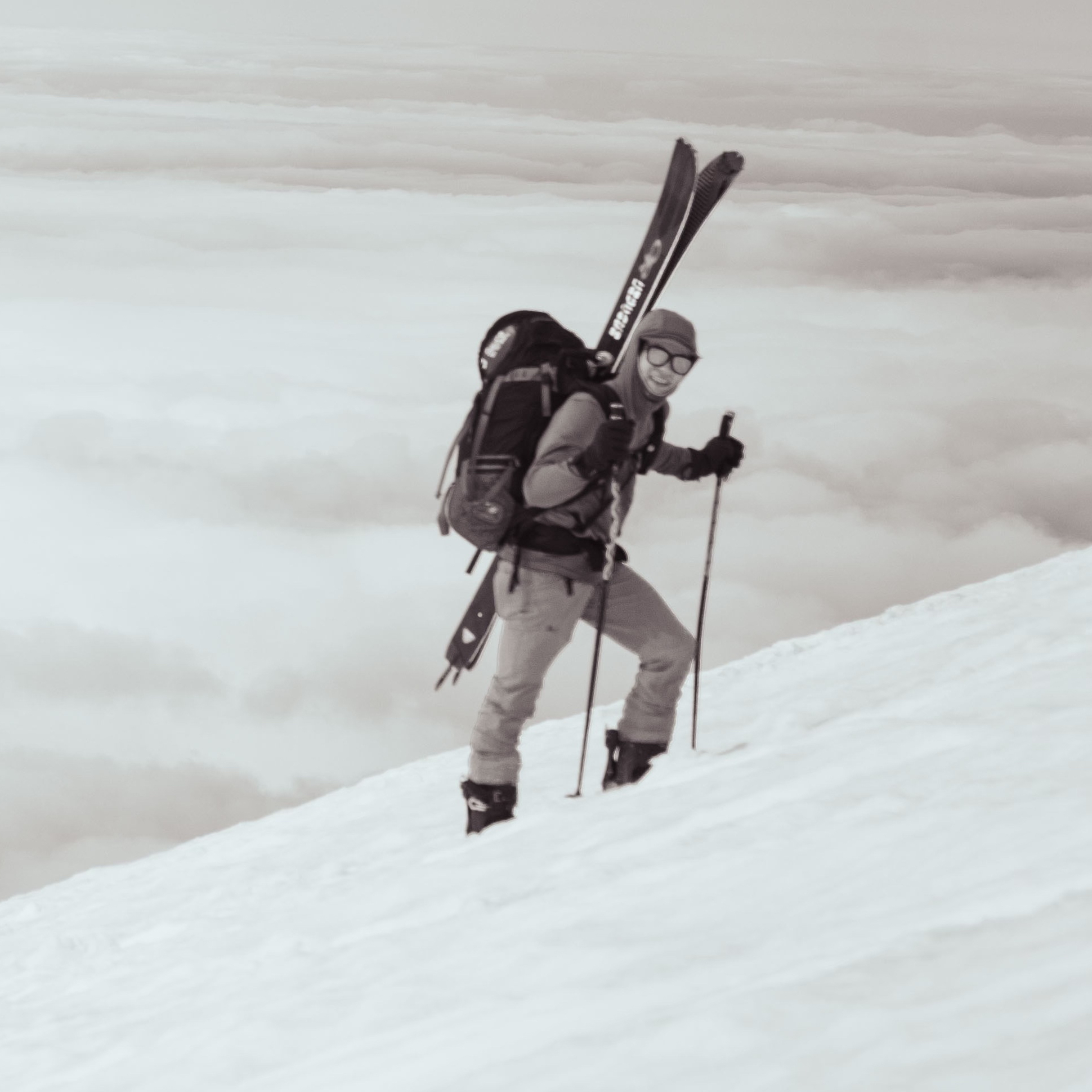

I’ve skied practically every month of the year, with plenty of help from Oregon’s Palmer Glacier and the October opening days at Copper Mountain, Colorado. With that said, September has been elusive. That all changed when I carved down the flanks of Mount Rainier this past Monday.
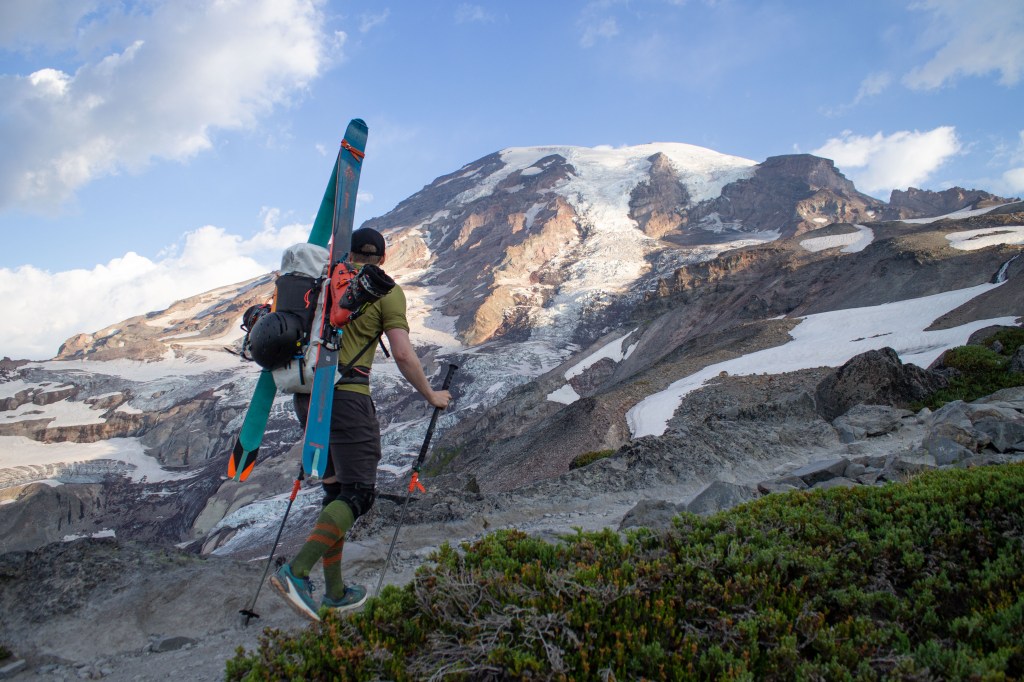
On Monday, September 2nd, Ben and I woke up at 4am to ski the Muir Snowfield, located on the southeastern flank of Mount Rainier. Though this was only his first summer living in Seattle, our outing would be his third this summer on the glacier.
Our objective for the day was to reach camp Muir at 10,000 ft and ski the snowfield below. In September, the Muir Snowfield extends down to around 7,000 feet, giving us a glorious descent. The snowfield is also ideal for its safety–the pitch isn’t usually greater than 30 degrees, and is protected from icefall due to its elevated position beside the Wilson and Nisqually glaciers.
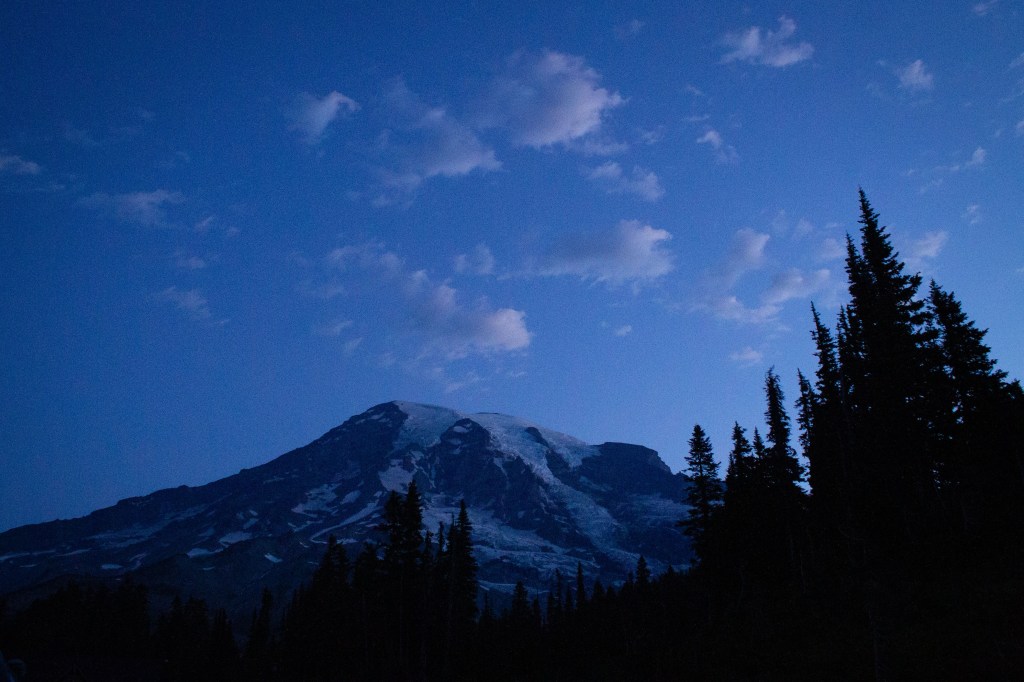
Still very much in the dark, we drove up the winding road to Paradise. When we arrived in the parking lot, we were greeted by the imposing, dark mass that was Mount Rainier. We assembled our packs and changed into the proper attire while the mountain began to light up in front of us.
At about 6am, we were on the trail. Our packs were heavy with gear, skis and boots. The path up to the snowfield is steep, and begins as a paved walkway. We began at tree line, eventually coming to a sprawling alpine meadow. At this hour, only the eager mountaineer or photographer could be seen.
Before long, the pavement turned into dirt. All the while, the mountain stood watching, dominating our path. We passed by a pair of deer, who also seemed to be enjoying the morning.
We climbed higher and higher in search of the snowfield’s terminus. After crossing a stream and gaining one last ridge, we got our first view of what we’d be skiing. Things were about to get fun.
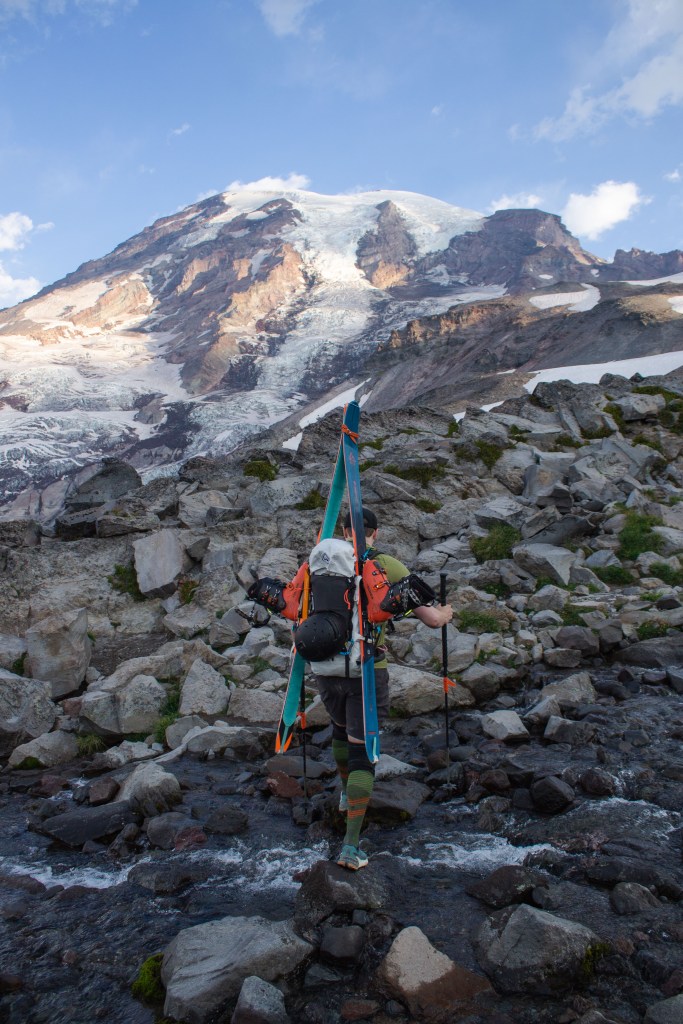
With much anticipation, we finally threw on our ski boots, stashing shoes behind a rock. When the slope mellowed out, it was time for the skis. With our packs light and motivation high, we charged ahead.

The skin up to Camp Muir was a mixed bag. We charged through some sections, and struggled on others. The snow was quite sticky, and for the most part, firm. The first half of the ascent was going well until we were faced with a scramble over a melted-out section.
Ski boots, as it turns out, aren’t the best for ascending glacial riverbeds. With that segment behind us, we moved onto the next section of snowfield. The last 2,000 vertical feet were steep, sun-cupped, and slippery. As we tried to cut switchbacks up the sun-pocked snowfield, our skins would slip at irregular intervals.
At last, the rudimentary shacks of Camp Muir grew larger at our approach. We arrived at the imposing outcrop of Anvil Rock, and clicked out of our skis. Taking a seat at camp, we joined the ranks of fellow mountaineers. Some peered over topographic maps, others milled around collecting water, and one group was there taking an into alpinism course.
Surprisingly–or not–we were the only skiers of the day on Mount Rainier. After a quick snack, we made our way back to the skis and prepared for an epic run down the wide-open snowfield.
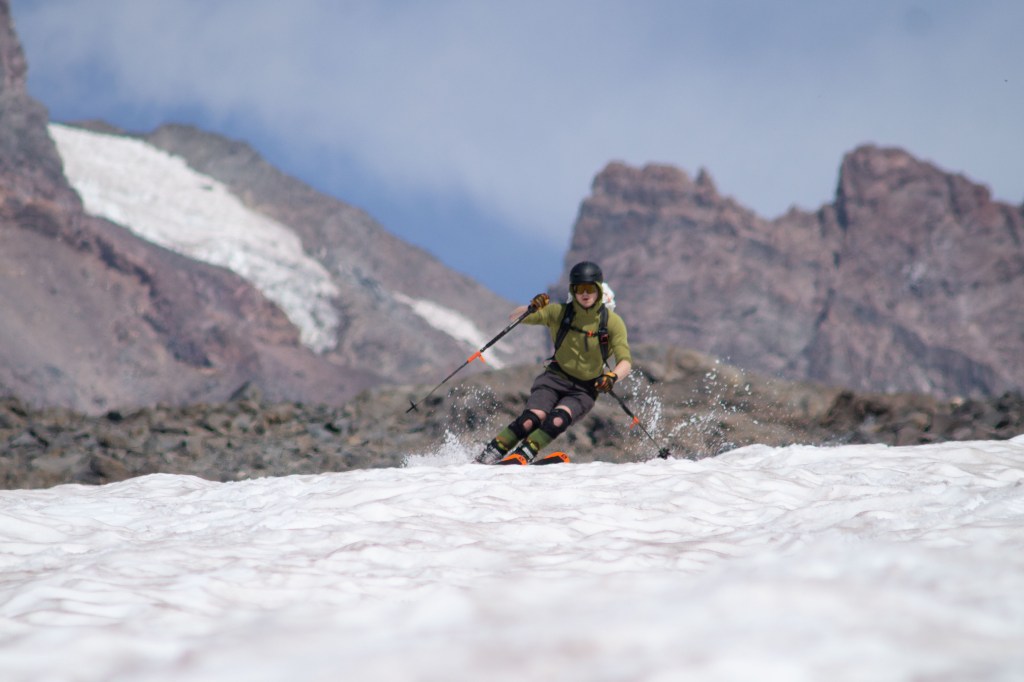
Despite enormous sun cups, the descent proved to be a real joy. I found rhythm between the sun cups, which acted as inverted moguls. It was possible to hop out of one depression and into another, something I did often.
According to Ben, the large size of the melted out cups led to a better ski surface. On his last trip a few weeks prior, the sun cups were too small to make turns through and were therefore tiresome. We still took a number of breaks as the elevation and tiring ascent sapped our legs of their energy.
After down climbing the rocky section, we enjoyed some turns on the best snow yet–nearly perfect September corn. We carved huge arcs, passing groups of amused climbers.
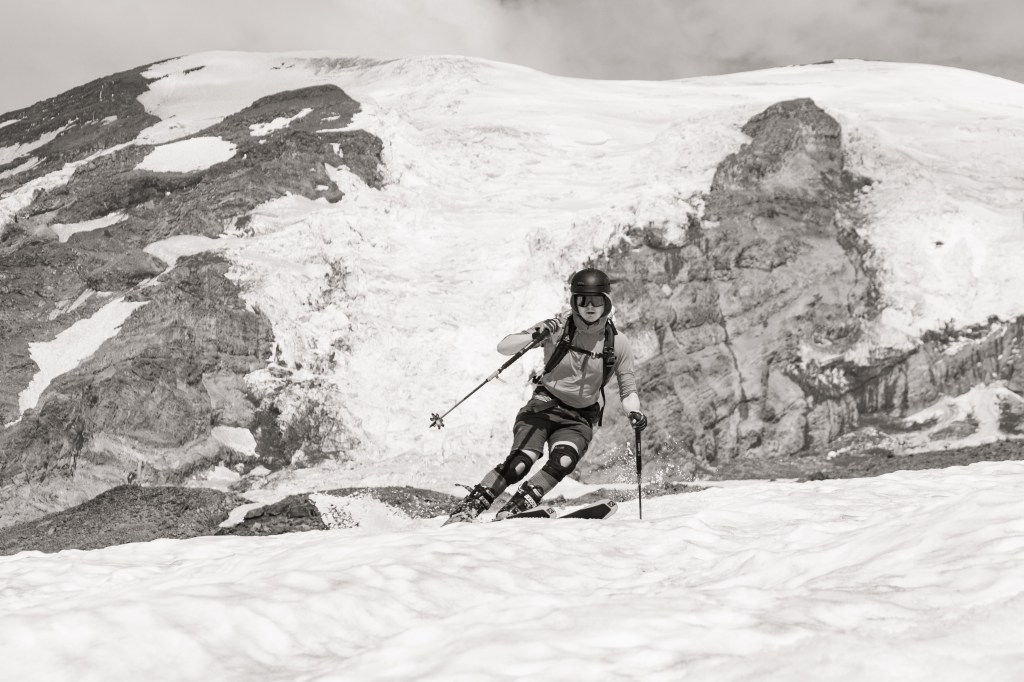
Making our last few turns of the summer, we arrived at the base of the snowfield. It was another two miles to the car with herds of day hikers gawking at our skis all the way. Calls of “woah, did you guys go skiing?” rang out in the late summer air.
It was just a typical September ski day on Washington’s most famous volcano.


 Noah's Adventures
Leave a comment